neuroscience logo designbrain science branding
How Neuroscience Is Transforming Logo Design
Neuroscience logo design is replacing subjective opinions with brain-based metrics. Learn how EEG, e...
Learn how color psychology in logo design triggers neurological and emotional responses. Research-backed guide to choosing brand colors strategically.
Learn how color psychology in logo design triggers neurological and emotional responses. Research-backed guide to choosing brand colors strategically.
Color is the first thing the brain registers when it encounters a logo. Before shape, before text, before any conscious evaluation, your visual cortex has already extracted chromatic information and routed it to the emotional centers of the brain. Understanding color psychology in logo design is not optional for anyone serious about branding -- it is the foundation that every other design decision rests on. Research shows that color can account for up to 90% of a consumer's snap judgment about a product Singh, 2006. That statistic alone should make you reconsider whether your brand's palette was chosen strategically or simply because someone on the team liked the shade.
The difference between a color that resonates and one that repels comes down to neurological mechanisms most designers never consider.
When light enters your eye, photoreceptor cells on the retina convert it into electrical signals. These signals travel through the optic nerve to the lateral geniculate nucleus, then on to the primary visual cortex (V1). Color processing begins here, but the critical part happens next: chromatic information is relayed to the amygdala and other limbic structures roughly 60-80 milliseconds before the brain finishes resolving shape and detail Singh, 2006.
That timing gap matters. It means color sets the emotional tone of your logo before the viewer recognizes what your logo actually depicts. A red logo has already triggered arousal. A blue logo has already triggered calm. By the time the viewer reads your brand name, the emotional context is established.
Three distinct aspects of color influence this process:
Most brand discussions focus on hue alone, ignoring saturation and lightness entirely. That oversight costs brands dearly. A navy blue and a sky blue are both "blue," but they trigger very different neural responses. Understanding how the brain processes logos in milliseconds clarifies why these nuances carry so much weight.
Labrecque and Milne's landmark study tested color-brand personality associations across large consumer samples and found that specific hues reliably activate specific personality dimensions Labrecque & Milne, 2012. Here is what the research shows for each major color family.
Blue is the most universally preferred color across demographics and cultures. It activates serotonin-associated neural pathways that promote feelings of calm and reliability. Financial institutions, technology companies, and healthcare brands choose blue at disproportionate rates -- and the reason is neurological, not just conventional.
In Labrecque and Milne's data, blue scored highest on the "competence" personality dimension Labrecque & Milne, 2012.
Best for: Finance, technology, healthcare, corporate services, SaaS platforms
Strategic consideration: Blue's dominance means differentiation is harder. If every competitor uses blue, your blue logo becomes background noise.
Red triggers the strongest physiological response of any color. Heart rate increases, breathing accelerates, and the amygdala registers heightened arousal. Elliot and Maier's review confirmed that red consistently enhances attentional capture and physical response across multiple contexts Elliot & Maier, 2014.
Brands like Coca-Cola, Netflix, and YouTube use red to signal energy and immediacy. Red logos demand attention in crowded visual environments.
Best for: Food and beverage, entertainment, retail, sports, media
Strategic consideration: Red can also signal danger and error (think stop signs, warning labels). In contexts where users are making cautious decisions -- healthcare, financial planning -- red may undermine the trust you need.
Green sits at the center of the visible light spectrum, making it the easiest color for the human eye to process. This low processing effort translates into a feeling of naturalness and balance. Green reliably activates associations with health, growth, and environmental responsibility.
Palmer and Schloss found that green preferences correlate strongly with positive associations people hold about green objects in the natural world -- grass, trees, vegetation Palmer & Schloss, 2010. Your brain essentially borrows the emotional residue of every pleasant green thing you have ever encountered and applies it to the logo.
Best for: Health and wellness, organic products, sustainability, finance (wealth), outdoor brands
Strategic consideration: Green has become crowded in the "eco-friendly" space. If sustainability is your differentiator, green reinforces the message. If it is just one of many brand values, green may pigeonhole your identity.
Yellow stimulates the nervous system and triggers feelings of optimism and warmth. It is also the most visually fatiguing hue because it reflects the most light. Yellow works best as an accent, not a dominant color. Pairing it with a high-contrast partner (black, dark blue, charcoal) maintains the optimistic association while solving readability problems on light backgrounds.
Best for: Children's brands, food, creative agencies, lifestyle
Orange combines the energy of red with the friendliness of yellow. It reads as approachable and energetic without the intensity of pure red.
Best for: Tech startups, creative agencies, food, fitness, budget-friendly brands
Purple has carried luxury associations for millennia, originating from the extreme rarity of Tyrian purple dye. Labrecque and Milne's data placed purple highest on the "sophistication" personality dimension Labrecque & Milne, 2012.
Best for: Luxury brands, beauty, education, creative services
Black creates maximum contrast and conveys maximum authority. It is the default for luxury fashion (Chanel, Prada, Gucci) and premium technology brands.
Best for: Luxury, fashion, technology, automotive, professional services
Choosing a hue is only step one. The saturation and lightness of that hue determine how the brain actually experiences it. Palmer and Schloss's research on color preferences demonstrated that people's preference for a color correlates more strongly with the desirability of objects associated with that specific shade than with the hue category alone Palmer & Schloss, 2010.
Practical implications for your brand:
A common mistake: choosing a color on one screen and never testing how saturation and lightness shift across different displays, print materials, and backgrounds. The emotional association you designed for can change dramatically in a new context. Our methodology page explains how algorithmic analysis accounts for these variations.
Individual color associations are real, but they do not exist in isolation. The interplay between your brand's colors creates a composite emotional signature that is greater than the sum of its parts.
Three foundational combination strategies:
Complementary colors (positioned opposite each other on the color wheel -- blue and orange, red and green) generate maximum visual tension and energy. They demand attention. Brands that want to feel bold and dynamic favor complementary schemes.
Analogous colors (neighbors on the color wheel -- blue, teal, and green) produce natural harmony and visual cohesion. They reduce cognitive friction and communicate stability. This is the default choice for brands that want to feel trustworthy and approachable.
Triadic colors (three equally spaced colors on the wheel) balance vibrancy with structure. They work well for brands targeting diverse audiences or communicating playfulness.
Beyond these classic frameworks, contrast hierarchy determines where the eye goes first. The element with the highest color contrast against its background captures attention first -- a principle eye-tracking research has confirmed repeatedly. If your icon uses your most contrasting color but you want people to read the brand name first, you have a structural conflict. Understanding how eye tracking reveals attention patterns helps diagnose these issues.
Western color associations dominate most branding discussions, but they do not apply globally. Some critical differences:
Elliot and Maier emphasized that while some color-response links appear to have biological underpinnings (particularly red's effect on arousal), many are learned through cultural and contextual exposure Elliot & Maier, 2014. If your brand operates internationally, your color palette needs to be tested against the cultural contexts of every target market -- not just your home market.
This is also where data-driven analysis outperforms intuition. Gut feelings about "what works" are shaped by the designer's own cultural background. An objective evaluation strips away those biases.
Here is a practical framework for selecting logo colors:
Step 1: Define your target emotional response. Write down the three emotions you want your logo to trigger. Competence? Excitement? Warmth? This narrows the hue families worth considering.
Step 2: Study your competitive landscape. Map the dominant colors in your category. If every competitor uses blue, consider whether a warm neutral or a confident green could differentiate you while communicating the right emotional tone.
Step 3: Select hue, then tune saturation and lightness. Pick the hue family that matches your target emotion, then adjust saturation and lightness to match your brand's energy level and market positioning.
Step 4: Build a hierarchy. Your primary color carries the emotional weight. Secondary colors support the palette. An accent color creates contrast for emphasis.
Step 5: Test across contexts. Check your palette on light and dark backgrounds, at small and large sizes, in digital and print. Verify contrast ratios meet WCAG requirements (minimum 4.5:1 for text). Roughly 8% of men and 0.5% of women have some form of color vision deficiency -- a palette that relies on red-green distinction alone fails for millions.
Step 6: Validate with data. Personal preference is not validation. Run your final palette through analysis that measures emotional associations, contrast performance, and accessibility. Analyze your logo to see how your color choices score.
Color accessibility is not a nice-to-have -- it is a trust signal. A logo that fails contrast requirements signals to accessibility-conscious customers that the brand does not prioritize inclusivity.
Practical minimums:
Blue consistently scores highest on trust and competence metrics across multiple large-scale studies Labrecque & Milne, 2012. However, trust is not built by color alone. Typography, spacing, alignment, and overall design quality all contribute to trust perception. A poorly designed blue logo will not automatically feel trustworthy.
Most effective logos use two to three colors. A primary color carries the emotional weight, a secondary color provides contrast and depth, and an optional accent color adds energy or emphasis. Research on processing fluency suggests that fewer colors reduce cognitive load and improve memorability Singh, 2006.
Yes. Singh's research found that 62-90% of initial product assessments are based on color alone Singh, 2006. Color influences not only whether consumers notice a product but whether they perceive it as appropriate for the category, trustworthy enough to purchase, and consistent with their self-image.
Following conventions (blue for finance, green for health) provides instant category recognition, but it also makes differentiation harder. The strategic question is whether category fit or distinctiveness matters more for your specific positioning. Brands that break color conventions intentionally -- like T-Mobile's magenta in the blue-dominated telecom space -- can gain significant attention advantages.
Test your logo against WCAG contrast ratio requirements using automated tools. A minimum 4.5:1 contrast ratio for text ensures readability. Additionally, simulate your logo under protanopia, deuteranopia, and tritanopia color vision conditions to verify that meaning is preserved. Our analysis tool includes automated accessibility scoring.
Your audience's neurological response to color is measurable, predictable, and backed by decades of research. The question is whether you are designing with that data or against it. Analyze your logo's color psychology with Logo Analyzer and get a complete breakdown of color harmony, emotional triggers, contrast ratios, and accessibility compliance.
Neuroscience logo design is replacing subjective opinions with brain-based metrics. Learn how EEG, e...
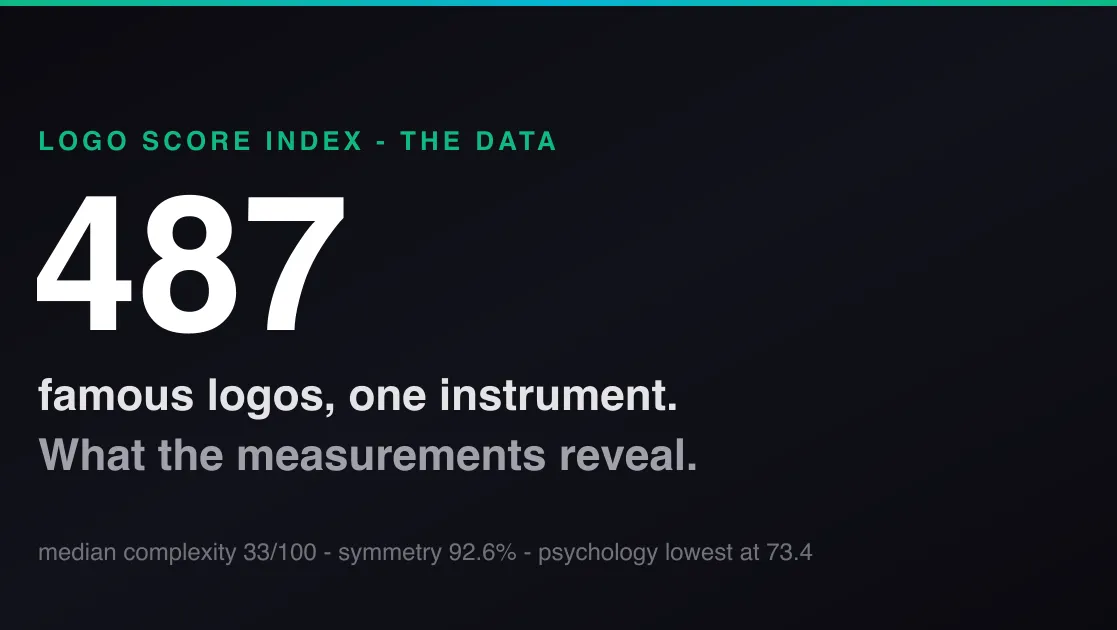
We ran 487 of the world's most famous logos through our full analysis pipeline. The data shows what ...

Geometric logo design builds instant credibility for your brand. Learn how clean shapes and modern p...
Get a free scientific analysis with 550+ metrics across perception and design.
Try Free Analysis