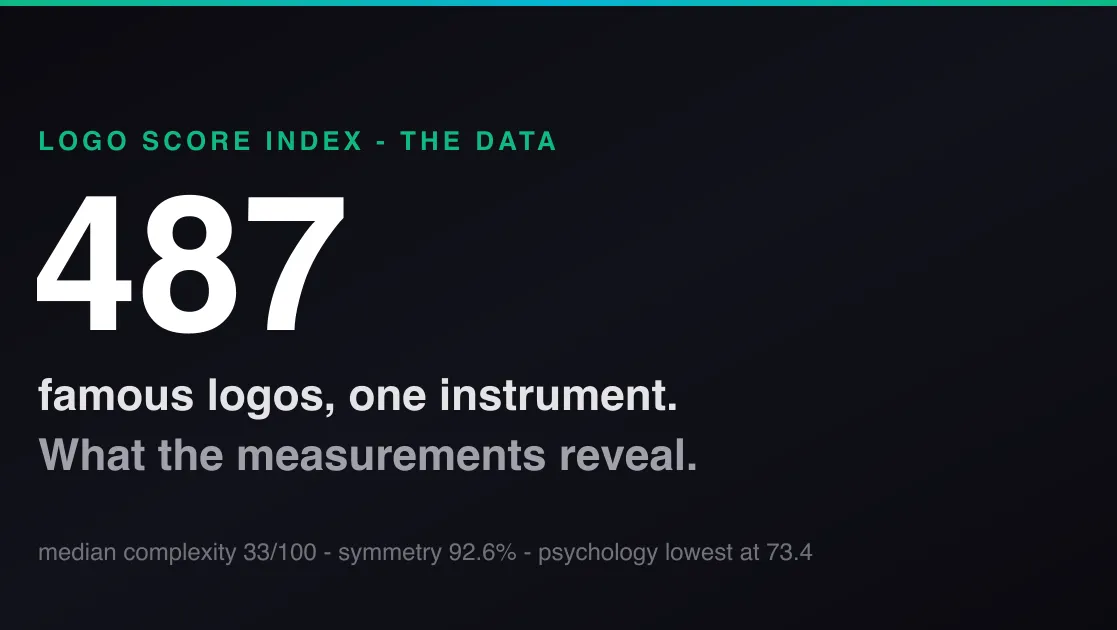
famous logoslogo design statistics
What 487 Famous Logos Reveal About Logo Design
We ran 487 of the world's most famous logos through our full analysis pipeline. The data shows what ...

Eye tracking logo design research shows where people really look. Learn how fixation patterns, saliency maps, and gaze data optimize brand marks.
Eye tracking logo design research shows where people really look. Learn how fixation patterns, saliency maps, and gaze data optimize brand marks.
Eye tracking logo design research has produced one of the most humbling findings in branding: what designers intend viewers to see and what viewers actually look at are frequently two different things. You can spend months perfecting a logo element that 80% of your audience never fixates on, and overlook a detail that captures first gaze every time. The gap between design intention and viewer reality is measurable, and the tool that measures it is eye tracking. By recording exactly where the eye lands, how long it stays, and what path it follows across your logo, logo eye tracking research strips away assumptions and replaces them with data. Understanding visual attention branding at this level transforms logo design from a subjective craft into an evidence-based discipline Duchowski, 2017.
Traditional eye tracking uses infrared cameras mounted below a screen to track corneal reflections. As your eye moves, the system records the position of your gaze at rates between 60 and 2,000 samples per second. This produces three primary data types:
From this raw data, researchers generate heatmaps (showing cumulative attention density), gaze plots (showing the order and duration of fixations), and areas of interest (AOI) analysis that quantifies how much attention specific logo elements receive Duchowski, 2017.
The practical problem with traditional eye tracking has always been access. Lab studies require specialized hardware, controlled environments, and participant recruitment, making them expensive and slow. Modern computational saliency models have changed this equation dramatically. These AI systems, trained on millions of human gaze recordings, predict where people will look with accuracy that rivals actual eye-tracking studies Kummerer, 2022. You can now get saliency predictions for any logo in seconds rather than weeks.
You can see this technology applied in our sample analysis reports, which include predicted attention heatmaps and fixation-point overlays for every logo analyzed.
The first fixation, where your eye lands in the opening 100–200 milliseconds of viewing, is arguably the most important data point in logo eye tracking research. It predicts downstream engagement, recall accuracy, and even trust formation. Pieters and Wedel's foundational research on visual attention in advertising established that initial fixation location significantly influences whether viewers process a visual further or disengage Pieters & Wedel, 2004.
Three factors dominate first-gaze attraction in logos:
Your visual cortex is fundamentally a contrast detection system. The element with the highest luminance contrast against its background almost always captures first fixation. This means a dark icon on a white background will attract the eye before a medium-gray wordmark on the same background, regardless of which element the designer considers more important.
Practical implications:
Larger elements attract fixation before smaller ones, a simple but frequently violated principle. When a logo's icon is physically larger than the wordmark, eye tracking data consistently shows the icon receiving first fixation, even when the designer intended a "logo-first" reading order. Visual weight (determined by density, darkness, and complexity) amplifies size effects. A compact, heavy element can outcompete a larger but lighter one for initial attention.
Research shows that the eye's first landing point tends to be near the "center of gravity" of a visual composition, the point where visual mass is concentrated. For symmetrical logos, this is typically the geometric center. For asymmetrical layouts, it shifts toward the heavier side. Understanding where your logo's center of gravity falls tells you where most viewers will begin their visual exploration Kummerer, 2022.
After the initial fixation, the eye follows predictable scanning patterns influenced by both the logo's visual hierarchy and the viewer's reading habits. Two well-documented patterns apply to logo viewing:
For logos with a roughly rectangular or square composition (icon left, text right, or stacked icon/text), Western viewers tend to follow a Z-shaped path: top-left to top-right, diagonal to bottom-left, then bottom-right. This pattern mirrors natural reading direction and has been documented extensively in web-design eye tracking studies.
For logo design, the Z-pattern means:
Text-dominant logos (wordmarks, letter-marks, and logos with prominent brand names) trigger the F-pattern documented by Nielsen in web-reading research. The eye scans the first few characters of the brand name horizontally, then drops down and scans a shorter horizontal segment, creating an F-shaped attention distribution.
The F-pattern has a critical implication for logo typography: the first two or three letters of your brand name receive disproportionate fixation time. If those opening characters are visually distinctive (through color, weight, or stylistic treatment), they anchor the entire brand impression. If they're generic, the brain may disengage before processing the full name.
Logos with circular or radial compositions (emblems, badges, concentric designs) produce a different scanning behavior. The eye typically enters at the most contrasting point on the perimeter, then spirals inward toward the center, or fixates on the center first if it contains high-contrast content. Eye tracking data for circular logos frequently shows a "clock-face" pattern where fixations cluster at 12, 3, 6, and 9 o'clock positions before exploring intermediate elements.
A saliency map is a visualization that predicts which parts of an image will attract the most visual attention. Bright areas on a saliency map indicate high predicted attention; dark areas indicate regions the eye is likely to skip. Modern deep-learning saliency models incorporate both bottom-up signals (contrast, color, edges) and top-down signals (learned attention biases, such as the tendency to look at faces or text) to produce predictions that closely match actual eye-tracking data Kummerer, 2022.
For logo evaluation, saliency maps answer a specific question: does the attention distribution match the importance hierarchy? If your brand name is the primary message but the saliency map shows the icon dominating, you have a structural misalignment between what you want people to see and what they will actually see.
Common findings from saliency analysis of logos:
Eye tracking data becomes actionable when you map attention patterns to specific design goals. Here's how to interpret common findings:
When an element receives heavy fixation time but viewers can't recall it afterward, the element is confusing rather than compelling. Extended fixation doesn't always mean engagement; it can mean the brain is struggling to decode what it's seeing. Henderson and Cote's research found that logos with high complexity and low "naturalness" produced exactly this pattern: viewers looked longer but remembered less Henderson & Cote, 1998.
The fix: simplify the problematic element. Reduce detail until the fixation pattern shifts from prolonged confusion to quick recognition.
If your brand name, differentiating feature, or key message receives minimal fixation, it needs more visual weight. Increase size, boost contrast, improve positioning (move it closer to the center of gravity), or reduce competing elements that are stealing attention.
A clean scanpath moves through a logo in a predictable sequence, typically from the primary element to the secondary element to the tertiary element. When eye-tracking data shows a chaotic, non-sequential gaze path, the visual hierarchy has failed. The viewer doesn't know where to look, so they look everywhere without processing anything deeply.
The fix: establish a clear dominance relationship between elements. One element should be unambiguously primary (largest, highest contrast, most centrally positioned). Everything else should be visually subordinate.
If the first fixation consistently lands on a secondary element (an icon detail, a background shape, a decorative flourish), your contrast hierarchy doesn't match your importance hierarchy. The most important element should also be the highest-contrast element. Understanding how your brain processes logos in milliseconds explains why this first-fixation mismatch has outsized consequences for brand perception.
Eye-tracking analysis can surface problems that traditional design critique misses entirely. Several common patterns indicate a logo that underperforms despite looking "fine" to the designer:
If any of these patterns sound familiar, they may also be signs that your logo needs a refresh. Eye tracking data provides the objective evidence to justify a redesign, and the specific direction for improvement.
Eye tracking measures three primary data types: fixations (where the eye pauses, typically 200–300 milliseconds), saccades (rapid jumps between fixation points), and scanpaths (the complete sequence of eye movements across the logo). These produce heatmaps showing attention density, gaze plots showing viewing order, and area-of-interest metrics showing how much attention specific elements receive Duchowski, 2017.
No. Modern AI saliency models, trained on millions of human gaze recordings, predict visual attention patterns with accuracy comparable to actual eye-tracking studies. These computational models can analyze any logo image in seconds, making attention analysis accessible without lab hardware or participant recruitment Kummerer, 2022.
The single most impactful finding is that first fixation location predicts overall brand perception. Where the eye lands first shapes the entire downstream impression, including trust, perceived quality, and memorability. If the first fixation lands on a high-quality, intentional element, perception improves. If it lands on a confusing or secondary element, the trust deficit is difficult to recover Pieters & Wedel, 2004.
Yes. Eye-tracking data shows that simple logos produce clean, directed scanpaths: the eye moves through the design in a logical sequence and exits with a clear impression. Complex logos produce scattered, chaotic gaze paths where the eye bounces between competing elements without settling. This increases cognitive load and decreases both memorability and positive affect Henderson & Cote, 1998.
Saliency maps are computational predictions of where people will look, generated by AI models trained on real eye-tracking data. Actual eye-tracking studies record where specific individuals looked in controlled conditions. Modern saliency models achieve high correlation with lab results for static images like logos, making them a practical substitute for most design evaluation purposes Kummerer, 2022.
You've designed your logo around what you think matters. Eye tracking reveals what your audience's visual system actually prioritizes, and the two rarely align perfectly. Analyze your logo with Logo Analyzer to get a complete attention analysis including predicted saliency maps, fixation-point rankings, and element visibility scores across 500+ metrics. The data will show you exactly what viewers see, what they skip, and what to change.
We ran 487 of the world's most famous logos through our full analysis pipeline. The data shows what ...

Geometric logo design builds instant credibility for your brand. Learn how clean shapes and modern p...
Discover how negative space branding creates memorable logos that stand out. Learn design techniques...
Get a free scientific analysis with 550+ metrics across perception and design.
Try Free Analysis