
color psychology brandingbrand color strategy
The Psychology of Color in Logo Design: How Hues Shape Brand Perception
Learn how color psychology in logo design triggers neurological and emotional responses. Research-ba...
Neuroscience logo design is replacing subjective opinions with brain-based metrics. Learn how EEG, eye tracking, and AI evaluate logos scientifically.
Neuroscience logo design is replacing subjective opinions with brain-based metrics. Learn how EEG, eye tracking, and AI evaluate logos scientifically.
For most of its history, logo design has operated on instinct. A designer creates options, a committee votes, and the winner is whichever mark the highest-paid person in the room prefers. Neuroscience logo design is dismantling that model. Over the past two decades, researchers have built a precise understanding of how the human brain processes visual identity, from the first retinal signal to long-term memory encoding, and that knowledge is now accessible outside the lab. Brain imaging, eye tracking, saliency mapping, and computational models trained on decades of cognitive research can evaluate a logo the way a focus group never could: objectively, repeatably, and in seconds Henderson & Cote, 1998. What follows is a breakdown of the specific neuroscience techniques, the cognitive principles behind them, and how Logo Analyzer operationalizes those research findings computationally — it simulates these neuroscience-validated responses rather than running EEG or fMRI itself.
The traditional logo evaluation process suffers from a fundamental flaw: human beings cannot accurately report their own subconscious responses. When you ask someone "Do you like this logo?" their answer reflects conscious rationalization, social pressure, and personal taste, none of which predict how the broader market will respond.
Reber, Schwarz, and Winkielman's research on processing fluency showed that people prefer visual stimuli they can process easily, but misattribute that preference to other factors, calling the design "creative" or "professional" when the real driver is neurological ease Reber et al., 2004. Subjective feedback doesn't just miss the mark. It actively misleads.
Neuroscience-based logo analysis sidesteps this problem by measuring what the brain actually does, not what the viewer claims to experience. You don't ask a patient if they think they have a fracture. You take an X-ray.
Three limitations of traditional evaluation that neuroscience resolves:
Multiple neuroscience techniques contribute to our understanding of how logos work in the brain. Each reveals a different dimension of the response.
EEG measures electrical activity across the scalp using an array of electrodes, capturing brainwave patterns with millisecond precision. In logo research, EEG reveals the temporal dynamics of visual processing: exactly when the brain registers different aspects of a design.
Key EEG findings relevant to logo design:
EEG excels at capturing the speed of brand recognition. Research shows that familiar brand logos trigger recognition-related brain activity within 200 milliseconds, before conscious awareness Henderson & Cote, 1998. This is why the "blink test" for logos isn't a metaphor. It's a neurological reality.
While EEG captures timing, fMRI reveals location: which brain regions activate in response to a logo. fMRI measures blood oxygen levels across the brain, producing spatial maps of neural activity.
Critical brain regions involved in logo processing:
fMRI studies confirm that strong brands activate reward-related brain regions (particularly the ventral striatum) in ways weak brands do not, independent of product quality. Your logo is a neural trigger for reward anticipation, or its absence.
Eye tracking records where a viewer's gaze lands, how long it dwells, and the sequence of fixation points across a visual stimulus. Saliency mapping takes this further by predicting attention patterns computationally, without requiring live participants.
Kummerer's research demonstrated that modern deep learning saliency models predict human fixation patterns with accuracy approaching inter-observer agreement, meaning the model predicts where you'll look about as well as another human would Kummerer, 2022. This makes large-scale logo evaluation practical.
What eye tracking and saliency reveal about logos:
You can explore how these principles apply to real logos through our eye tracking analysis, which explains the methodology behind gaze prediction.
If there is a single neuroscience concept that every designer and brand manager should understand, it's processing fluency: the subjective experience of ease or difficulty when the brain processes a stimulus.
Reber and colleagues established that processing fluency directly influences preference, trust, and perceived truth Reber et al., 2004. When a visual stimulus is easy to decode, the brain rewards that ease with a positive affective response. The viewer experiences this as liking the design, trusting the brand, or feeling that the message "rings true." They never realize the feeling originates from neurological processing efficiency rather than from the content itself.
For logos, processing fluency is determined by several measurable factors:
Henderson and Cote's research found that logos scoring highest on recognition and positive affect shared two traits: natural design (flowing, organic forms) and low-to-moderate complexity Henderson & Cote, 1998. These are direct predictors of processing fluency.
The practical implication is clear: before asking whether a logo is "creative" or "on-brand," ask whether it is fluent. A fluent logo builds trust and preference automatically. A disfluent one forces the brain to work harder, and that effort gets misattributed as doubt about the brand.
EEG machines cost tens of thousands of dollars. fMRI sessions run hundreds of dollars per hour. Eye tracking labs require dedicated space and participant recruitment. These methods are invaluable for research but impractical for evaluating the average brand's logo.
Logo Analyzer bridges this gap with computational models that simulate neuroscience-validated responses. The platform scores every logo across 500+ metrics organized into 17 scientific dimensions, each grounded in published cognitive science research.
Here is how specific neuroscience principles map to the analysis:
Processing fluency assessment: The system evaluates figural complexity, symmetry, color contrast ratios, typographic legibility, and Gestalt compliance. These factors are weighted based on Reber et al.'s fluency research to predict the ease with which the brain will decode the mark.
Saliency prediction: Deep learning models trained on eye tracking datasets generate attention heatmaps and fixation point predictions for each logo. These reveal whether the viewer's gaze follows the intended visual hierarchy or gets misdirected by competing elements.
Emotional response modeling: Color-emotion associations derived from Labrecque and Milne's research, shape psychology from geometric moment analysis, and brand personality dimensions from Aaker's framework combine to predict the emotional profile the logo is likely to trigger.
Memorability scoring: Drawing on Henderson and Cote's recognition research and distinctiveness metrics derived from competitive analysis, the system estimates how effectively the logo will encode into long-term memory.
Trust and credibility signals: Alignment precision, proportional consistency, typographic weight, and color stability are measured against the visual trust heuristics documented in brand perception literature.
Van der Lans, Pieters, and Wedel demonstrated that objective visual features predict consumer logo evaluations systematically across cultures Van der Lans et al., 2009. Their framework validates the approach of measuring design attributes computationally rather than relying on subjective panels.
You can see these metrics in action through our sample analysis reports, which show the full breakdown for real logos.
Neuroscience-based logo analysis isn't just an academic exercise. It solves specific, recurring problems in brand management and design workflow.
Design critiques are notoriously subjective. "I don't like the blue" is feedback. "The blue triggers competence associations that conflict with your warmth positioning, and fluency drops 23% at mobile scale due to thin stroke weight" is a diagnosis. Neuroscience-based analysis provides the latter.
Practical applications for design teams:
Logo refreshes and rebrands require budget approval, and "the logo feels outdated" rarely survives a CFO's scrutiny. Neuroscience metrics reframe the conversation: your logo scores in the bottom quartile for trust perception, your memorability index is 40% below the competitive average, or your emotional profile triggers caution rather than confidence.
Practical applications for brand managers:
Early-stage companies rarely get a second chance at visual identity. Neuroscience-based evaluation during the design process catches problems (low memorability, unintended emotional associations, poor scalability) before they become embedded in market perception.
It applies cognitive science findings, including processing fluency, eye tracking, saliency mapping, and emotional response modeling, to evaluate how the brain responds to a logo. Instead of subjective opinions, it measures objective visual attributes that predict recognition, memorability, trust, and preference Henderson & Cote, 1998.
No. While EEG and fMRI require laboratory equipment, computational models trained on neuroscience research simulate these responses from a standard logo image. Saliency models predict eye tracking patterns with accuracy approaching human inter-observer agreement Kummerer, 2022. Logo Analyzer makes these models accessible without specialized hardware.
Modern saliency models achieve prediction accuracy within the range of human-to-human agreement on fixation patterns Kummerer, 2022. Processing fluency predictions are grounded in decades of replicated research on visual complexity, symmetry, and figural goodness Reber et al., 2004. No model replaces live testing with your specific audience, but computational analysis provides reliable directional guidance and identifies problems that subjective review misses.
Processing fluency is the brain's subjective experience of how easy or difficult a stimulus is to decode. High-fluency logos feel familiar, trustworthy, and appealing, even on first viewing, because the brain interprets processing ease as a positive signal Reber et al., 2004. Logos with clean geometry, sufficient contrast, legible typography, and moderate complexity score highest on fluency. You can measure your logo's fluency through our analysis methodology.
Neuroscience-based analysis can compare logos on specific dimensions: processing fluency, saliency, predicted memorability, emotional profile, and trust signals. "Better" depends on your strategic goals, since a logo optimized for trust will score differently than one optimized for excitement. The value is in precise, dimensional comparison rather than a single ranking. You can run a head-to-head evaluation using our comparison tool.
Now you understand the neuroscience behind effective logo design, from processing fluency to saliency mapping to emotional response modeling. The next step is applying these principles to your own mark. Analyze your logo with Logo Analyzer and get a breakdown of how the brain responds to your brand's visual identity. No lab equipment. No subjective opinions. Just data grounded in decades of cognitive science.
Learn how color psychology in logo design triggers neurological and emotional responses. Research-ba...
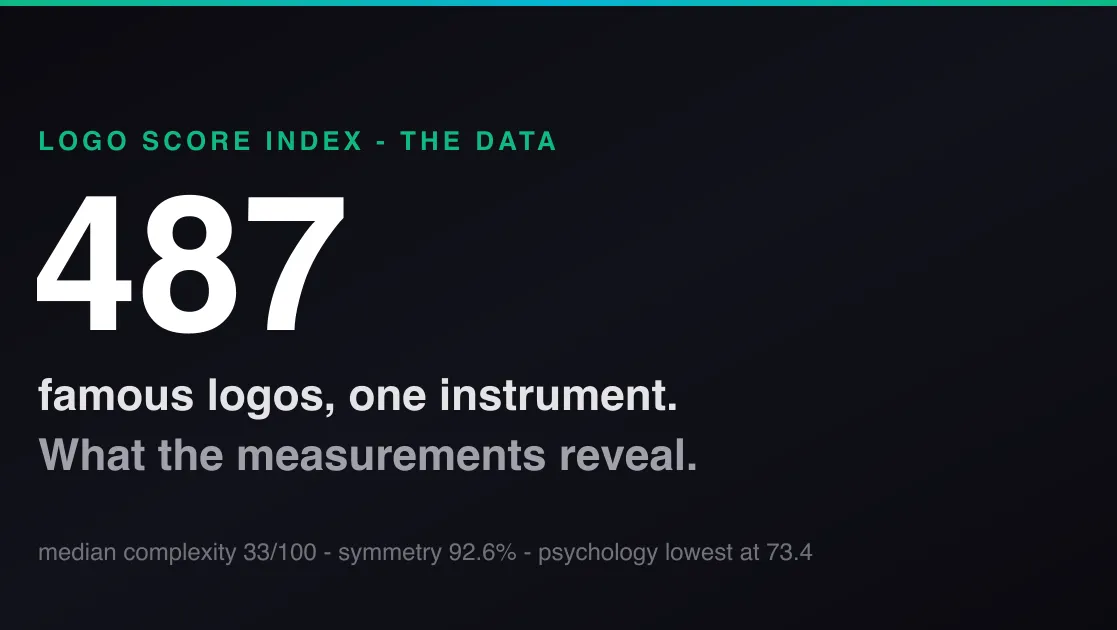
We ran 487 of the world's most famous logos through our full analysis pipeline. The data shows what ...

Geometric logo design builds instant credibility for your brand. Learn how clean shapes and modern p...
Get a free scientific analysis with 550+ metrics across perception and design.
Try Free Analysis