famous logoslogo design statistics
What 487 Famous Logos Reveal About Logo Design
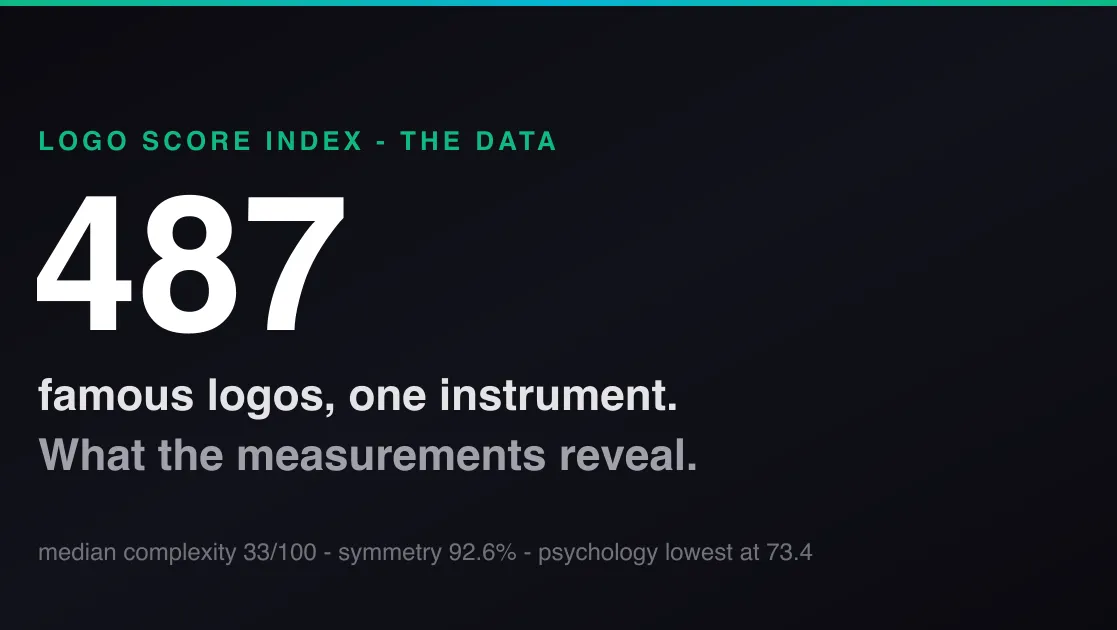
We ran 487 of the world's most famous logos through our full analysis pipeline. The data shows what ...

Your logo drives trust, recognition, and revenue. Learn why your logo matters with research-backed data on brand identity ROI and common mistakes.
Your logo drives trust, recognition, and revenue. Learn why your logo matters with research-backed data on brand identity ROI and common mistakes.
Every business owner eventually asks the question: does my logo really matter that much? The short answer is yes -- why your logo matters goes far beyond aesthetics. Your logo is the single most repeated visual element of your entire brand. It appears on every invoice, email signature, social media profile, product package, storefront sign, and advertisement your company will ever produce. Over the lifetime of a business, that mark will be seen thousands, potentially millions, of times. Henderson and Cote's foundational research on logo design demonstrated that well-designed marks produce significantly stronger recognition, more positive affect, and clearer brand meaning than poorly designed ones -- effects that compound with every exposure Henderson & Cote, 1998.
Yet most businesses treat logo design as a checkbox item -- something to finalize quickly between registering a domain and printing business cards. That approach leaves measurable money on the table. Brand identity is not a cost center. It is infrastructure, and like all infrastructure, the quality of what you build determines the weight it can bear.
Research from multiple institutions confirms that humans form visual judgments about a brand in as little as 50 milliseconds -- 0.05 seconds. There is no second attempt at this evaluation. By the time a viewer becomes consciously aware of your brand, their brain has already assessed it across four dimensions:
Your logo is the primary input for all four judgments. Not your tagline. Not your product description. Not your pricing page. The visual mark arrives first, and it anchors every subsequent evaluation through a well-documented cognitive mechanism called the halo effect.
Foroudi et al. studied the relationship between corporate visual identity and favorable brand image. Their findings were unambiguous: visual identity elements -- logo, color scheme, typography -- significantly predicted consumer perceptions of corporate reputation, even when controlling for product quality and price Foroudi et al., 2014. In plain terms, a strong logo makes people think your product is better before they have tried it. A weak logo does the opposite.
This is also why understanding how eye tracking reveals what people actually see in your logo is so valuable. The elements that capture attention in those first milliseconds determine the direction of the entire judgment cascade.
The connection between strong visual identity and business performance is not anecdotal. Quantitative evidence links brand presentation to revenue outcomes:
Machado et al. examined the direct link between logo design characteristics and consumer evaluations. Their research found that logos rated higher on design quality produced significantly more favorable brand attitudes, stronger purchase intentions, and greater willingness to pay a price premium Machado et al., 2015. The effect was not subtle. Well-designed logos outperformed poorly designed ones even when participants were told the products behind them were identical.
These numbers reframe the logo question entirely. The relevant question is not "can we afford to invest in our logo?" but "can we afford the revenue we are losing by not investing?"
Aaker's framework for brand equity identifies visual identity as one of the foundational assets that drive brand value over time Aaker, 1997. Brand equity compounds: every positive interaction a customer has with your visual identity strengthens their association with your brand, which increases the likelihood of repeat purchase, referral, and price tolerance.
A strong logo does not just help you win the first sale. It builds an asset that appreciates with every exposure. A weak logo does the opposite -- it leaks value at every touchpoint, forcing you to spend more on advertising, sales, and customer acquisition to compensate for what your brand identity fails to deliver on its own.
Not all logos are created equal. Research has identified specific visual characteristics that separate effective marks from ineffective ones.
The human brain processes simple shapes faster and stores them in memory more efficiently. Henderson and Cote's study found that logos rated low in complexity scored significantly higher on recognition tests, even after minimal exposure Henderson & Cote, 1998. Nike's swoosh. Apple's apple. Target's bullseye. The world's most recognized logos are also among its simplest.
This is not coincidence. The brain rewards low processing effort with a feeling of fluency -- a sense that the stimulus is familiar, safe, and true. Psychologists call this processing fluency, and it directly influences trust perception.
Simplicity without distinctiveness produces generic marks. Your logo must be simple enough to process fluently and different enough from competitors to register as novel. The visual cortex prioritizes novelty -- elements that break expected patterns receive more attention and deeper memory encoding.
If your fintech logo looks like every other blue geometric mark in the space, it is functionally invisible. Distinctiveness is what converts visual exposure into brand recognition. Running a logo comparison against direct competitors reveals where you sit on the distinctiveness spectrum.
Different industries require different emotional signatures. A children's hospital needs warmth and care. A cybersecurity firm needs authority and precision. A lifestyle brand needs approachability and aspiration.
Your logo's shapes, colors, and typography all contribute to the emotional profile viewers experience. Machado et al. found that the alignment between a logo's emotional tone and the brand's category expectations was a stronger predictor of favorable evaluations than design quality alone Machado et al., 2015. A beautifully designed logo that sends the wrong emotional signal for its category actually performs worse than a mediocre logo that sends the right one.
Your logo must work at 16x16 pixels (a browser favicon) and on a 20-foot billboard. Logos that look elegant at presentation size frequently become unrecognizable at small scales -- the sizes where the majority of first impressions now happen (social media avatars, app icons, mobile search results).
Scalability is not just a production concern. It is a neurological one. A logo that degrades at small sizes fails the brain's edge-detection systems, producing a fuzzy signal that gets categorized as low-quality. Every degraded rendering is a trust-erosion event.
All elements of a logo -- icon, typography, color, spacing -- must feel like they belong together. Incoherent logos (where the icon style clashes with the font style, or the color palette contradicts the shape language) create cognitive dissonance. The brain detects this dissonance in the anterior cingulate cortex, the same region responsible for error detection. The result is a subtle feeling that something is wrong, which undermines trust before the viewer can articulate why Foroudi et al., 2014.
Understanding what works is only half the picture. Knowing what fails -- and why -- prevents expensive missteps.
When every stakeholder gets a vote, the result is a compromise that satisfies no one and communicates nothing. Logo design requires a clear strategic brief and decisive creative leadership.
Design trends have a shelf life of 2-3 years. A logo built around a trending aesthetic will feel dated quickly. The best logos are trend-aware but not trend-dependent.
A logo that looks perfect on a white slide may fail on a dark background, a mobile screen, or a circular social media crop. Logos must be designed for every context they will inhabit.
The most pervasive mistake: evaluating a logo by showing it to colleagues and asking "what do you think?" People cannot reliably articulate subconscious visual responses. They say "looks nice" while their brain signals distrust due to spacing issues, contrast failures, or emotional misalignment.
Neuroscience-based analysis changes this equation. By modeling how the brain processes visual information, you can measure attention distribution, emotional triggers, cognitive load, and trust signals. Our methodology page explains how this works.
Trust is arguably the most important outcome your logo can influence, and the link between visual quality and perceived business quality is well-established. Foroudi et al. demonstrated that consumers use corporate visual identity as a heuristic for organizational competence -- a mental shortcut that says "if they invest in how they look, they probably invest in what they do" Foroudi et al., 2014.
This heuristic operates below conscious awareness. A viewer does not think "this logo has poor kerning, therefore this company is unreliable." They simply feel less confident, less willing to click, less inclined to share their credit card number.
The trust gap -- the distance between the quality your business delivers and the quality your visual identity communicates -- is one of the most expensive problems a brand can have. Symptoms include:
Closing this gap is often one of the highest-ROI investments available. It does not always require a complete rebrand -- sometimes adjusting typography, refining spacing, or recalibrating color saturation is enough.
Timing matters. There are specific inflection points where logo investment produces outsized returns:
Henderson and Cote found that even minor modifications to logo design elements -- adjusting proportions, simplifying geometry, refining curves -- could significantly improve recognition and affect scores without sacrificing existing brand equity Henderson & Cote, 1998. Evolution, not revolution, is usually the right approach.
There is no universal budget, but logo quality directly predicts consumer attitudes and purchase intention Machado et al., 2015. Underspending produces a mark that leaks trust and recognition at every touchpoint. Invest enough for a strategically informed, professionally executed design -- then validate with data before finalizing.
Yes. Logo effectiveness depends on design quality, not budget size. Henderson and Cote's research showed that simple, well-crafted marks outperformed expensive but complex ones on recognition and affect Henderson & Cote, 1998. A small business with a clean, distinctive, strategically appropriate logo can project as much professionalism as a Fortune 500 company.
Evaluate every 3-5 years, but update only when the data supports it. Signs that a refresh is needed include poor performance at mobile sizes, low distinctiveness versus competitors, misalignment between your logo's emotional tone and your current brand positioning, or failing accessibility standards. Avoid changing for the sake of change -- each modification carries a recognition equity cost.
Machado et al. found that logo design quality significantly predicted purchase intention and willingness to pay a premium, even when the underlying product was held constant Machado et al., 2015. Brand consistency -- which starts with the logo -- has been correlated with revenue increases of up to 23%. The effect is indirect but powerful: stronger logo leads to stronger recognition leads to stronger trust leads to higher conversion.
If forced to choose one, recognizability. A logo that is not recognized cannot build equity, trigger trust, or drive recall. Recognizability emerges from the combination of simplicity (easy to process), distinctiveness (different from competitors), and consistency (same mark across all touchpoints) Henderson & Cote, 1998.
If your logo was designed without a strategic brief or has never been measured against objective criteria, you are likely leaving recognition, trust, and revenue on the table. Analyze your logo with Logo Analyzer -- it takes about four minutes. See how the human brain responds to your brand's most important visual asset, scored across 500+ neuroscience-backed metrics.
We ran 487 of the world's most famous logos through our full analysis pipeline. The data shows what ...

Geometric logo design builds instant credibility for your brand. Learn how clean shapes and modern p...

Discover how negative space branding creates memorable logos that stand out. Learn design techniques...
Get a free scientific analysis with 550+ metrics across perception and design.
Try Free Analysis