industry applicationsbeauty
Beauty Logo Design That Captivates at First Glance
Discover stunning beauty logo design ideas that captivate customers instantly. Learn proven strategi...
Restaurant logo design that attracts customers and builds brand loyalty. Learn proven strategies to create memorable logos that drive dining traffic today.
Restaurant logo design that attracts customers and builds brand loyalty. Learn proven strategies to create memorable logos that drive dining traffic today.
A restaurant lives or dies by first impressions, and that impression increasingly happens on a screen, not at your front door. Your restaurant logo design is the thing people see before they taste a single bite. It shows up on Google Maps, Uber Eats thumbnails, Instagram tags, and the sign above your entrance. Get it wrong, and diners scroll past without a second thought. Get it right, and you've already started selling the experience.
I once worked with a Mediterranean grill that couldn't figure out why their online orders lagged behind a competitor with objectively worse food. The answer was sitting right on their delivery app profile: a cluttered logo with four colors, a fork-and-knife icon, and script text nobody could read at 40 pixels wide. The competitor? Clean wordmark, one accent color, done.
So what actually makes a restaurant logo work? Let's break it apart.
Red and yellow dominate fast food for a reason: they stimulate hunger and urgency. But the psychology of color in restaurant branding goes far beyond the McDonald's playbook.
Research by Spence et al. 2014 found that color associations with food are deeply culturally embedded and influence taste expectations before consumption even begins. Warm tones (reds, oranges, deep yellows) consistently correlate with appetite stimulation across Western markets. Cool tones like blue and purple tend to suppress it, which is why you almost never see a blue fast-casual logo.
Here's what's interesting: fine dining plays by different rules entirely. High-end restaurants frequently use black, white, gold, or deep navy. Why? Because they're not trying to make you hungry. They're signaling exclusivity and sophistication. The appetite trigger matters less when your average check is $180.
Think about it this way:
Your color palette should match the emotional promise of your dining experience. A farm-to-table brunch spot using the same red as a pizza chain sends a confusing signal. Diners might not articulate why something feels off, but their brain registers the mismatch instantly.
Before a single word is read, the shape of your letterforms communicates cuisine type, price range, and atmosphere. Typography might be the most underestimated element in restaurant logo design.
Serif fonts, especially high-contrast ones like Didot or Playfair Display, read as formal, established, European. They're the default for steakhouses, French bistros, and wine-focused concepts. Sans-serif fonts signal modernity and casual confidence. Think Sweetgreen or Chipotle.
Script and hand-lettered logos occupy interesting territory. They can feel artisanal and personal (great for bakeries and coffee shops) or dated and generic (the dreaded "Italian restaurant cursive" that plagues strip malls everywhere). The difference usually comes down to execution quality and originality.
One thing designers overlook: legibility at small sizes matters more for restaurants than almost any other industry. Your logo will appear on delivery apps at roughly 80×80 pixels. It'll sit on a Google Maps pin. It'll be printed on receipts and stamped on takeout bags. If your beautiful hand-lettered script turns into an illegible smudge below 200 pixels, you have a functional problem, not just an aesthetic one.
Test your logo at every size it'll actually be used. Not just on a pristine Behance mockup.
Forks. Knives. Chef hats. Flames. Steam rising from a plate. These icons are the clip art of restaurant branding, and they do almost nothing to differentiate your concept.
Consider this: if you removed the text from your logo and showed only the icon, would anyone know which restaurant it belonged to? For most concepts, the answer is no. That's a problem. Generic food imagery creates generic brand perception.
The strongest restaurant logos tend to do one of two things with imagery. They either skip it entirely (wordmark-only approaches like Nobu, Noma, or Eleven Madison Park) or they use something unexpected that connects to the restaurant's specific story. A neighborhood taqueria might reference its street address. A seafood restaurant might abstract a wave pattern rather than drawing a literal fish.
Brands in other industries face similar temptation toward cliché imagery. In animal logo design and pet industry branding, for example, the impulse to slap a paw print on everything is just as strong, and just as ineffective at creating distinction. The same principle applies to pet brand logo design, beauty brand identity, and cosmetics branding: the most memorable marks avoid category defaults.
If your icon could work for any restaurant in your category, it's not doing its job.
More than 60% of restaurant discovery now happens digitally Deloitte, 2023. That means your logo's most important canvas isn't your storefront. It's a 3-inch phone screen.
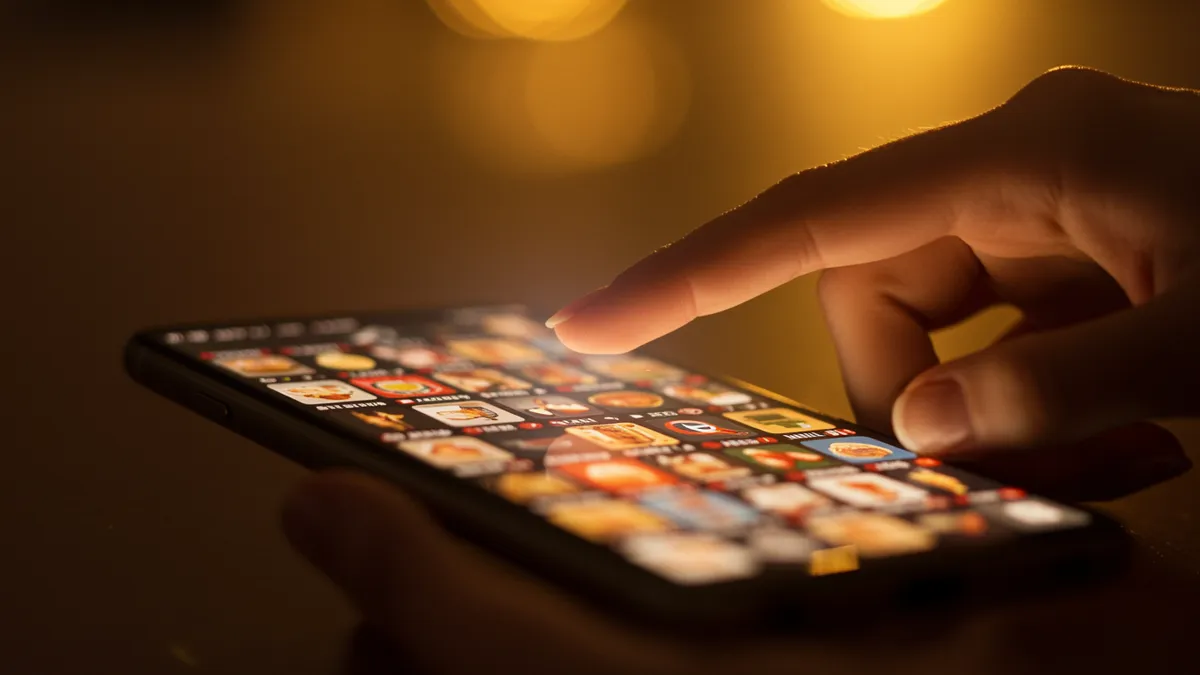
Delivery platforms like DoorDash, Grubhub, and Uber Eats display logos as small circular or square thumbnails. This creates brutal constraints. Fine details vanish. Thin lines disappear. Color subtlety becomes muddy.
Here's a quick test I recommend to every restaurant client:
If yours doesn't get picked, you have a visibility problem. And visibility is the prerequisite to everything else: you can't communicate your brand story if nobody notices you exist.
Quick reality check: this isn't about making your logo louder or more colorful. It's about structural clarity. Logos with strong silhouettes, high figure-ground contrast, and simple geometry perform best at small sizes. Eye-tracking research consistently shows that the human eye fixates first on shapes with clear boundaries, even in cluttered visual environments.
Worth noting: many restaurants now maintain a simplified "app version" of their logo alongside their full mark. If your primary logo doesn't scale down gracefully, designing a dedicated small-format variant isn't a compromise. It's smart brand management.
A restaurant logo isn't just a visual identifier. It's a promise. And broken promises drive diners away faster than a bad Yelp review.
Research on expectation-confirmation theory Oliver, 1980 shows that customer satisfaction depends heavily on whether an experience matches prior expectations. Your logo sets those expectations. A rustic, hand-drawn mark promises warmth and imperfection. A sleek geometric wordmark promises precision and modernity. Neither is better. But misalignment between the logo's signal and the actual dining experience creates cognitive dissonance that tanks repeat visits.
I've seen this mistake countless times. A casual poke bowl shop with a logo that looks like a Michelin-starred restaurant. A high-end sushi bar with branding that screams fast casual. The food might be excellent in both cases, but the logo attracted the wrong audience: people who walked in expecting something different from what they got.
Before designing (or redesigning), answer these honestly:
Your logo should be the visual translation of those answers. Running a logo analysis through a neuroscience-backed analysis framework can reveal whether your mark actually communicates what you think it does. The gap between intention and perception is where brands lose customers.
Not every struggling restaurant needs a new logo. Sometimes the problem is marketing, location, or, let's be honest, the food. But there are clear signals that your visual identity is holding you back.
If your logo was designed more than 10 years ago and hasn't been touched, there's a good chance it looks dated on digital platforms. If you've significantly changed your concept (shifted from casual to upscale, or pivoted your cuisine) your original mark probably no longer fits. And if you consistently hear "I expected something different" from first-time diners, that's your brand identity misfiring.
But here's the catch: redesigning a logo for a restaurant with loyal regulars carries real risk. Familiarity breeds comfort, and comfort drives repeat visits. Starbucks learned this when their 2011 logo update sparked backlash, though the simplified siren ultimately proved more versatile across formats.
The safest path for established restaurants is evolution, not revolution. Refine the typography. Tighten the color palette. Simplify the icon. Keep the DNA while improving the execution. Check our guide on signs your logo needs a refresh if you're on the fence.
For new concepts, you have more freedom, and more responsibility to get it right from day one.
A strong restaurant logo is legible at small sizes, uses color and typography that match the dining experience, and avoids generic food imagery. It should work equally well on a storefront sign and a delivery app thumbnail. Simplicity and emotional alignment with your concept matter more than complexity.
Expect to invest $1,500–$10,000 for professional restaurant logo design, depending on the designer's experience and deliverable scope. Budget concepts might get away with $500–$1,000, but cutting corners on brand identity often costs more in the long run through lost customer recognition and eventual redesigns.
Not necessarily. Many of the world's most successful restaurants use text-only logos. If you do include imagery, make it specific to your concept rather than generic: avoid ubiquitous forks, chef hats, and flames. An original visual element beats a category cliché every time.
You can, but you may need an adapted version optimized for small digital formats. Many restaurants now maintain a primary logo for signage and menus alongside a simplified mark for apps and social media profiles. Consistency in color and typography ties both versions together.
Your restaurant logo is working for you right now, or it's working against you. If you're not sure which, analyze your logo with our neuroscience-backed platform and find out exactly what your mark communicates to hungry diners before they ever read your menu.
Discover stunning beauty logo design ideas that captivate customers instantly. Learn proven strategi...
Discover how AI analysis transforms travel logo design into stunning visual identities. Learn expert...

Learn how construction logo design builds client trust and establishes your brand. Discover proven s...
Get a free scientific analysis with 550+ metrics across perception and design.
Try Free Analysis