
design principleslogo
Logo Format Guide to Nail Every Platform
Master every platform with our logo format guide. Learn which file types work best for web, print, a...
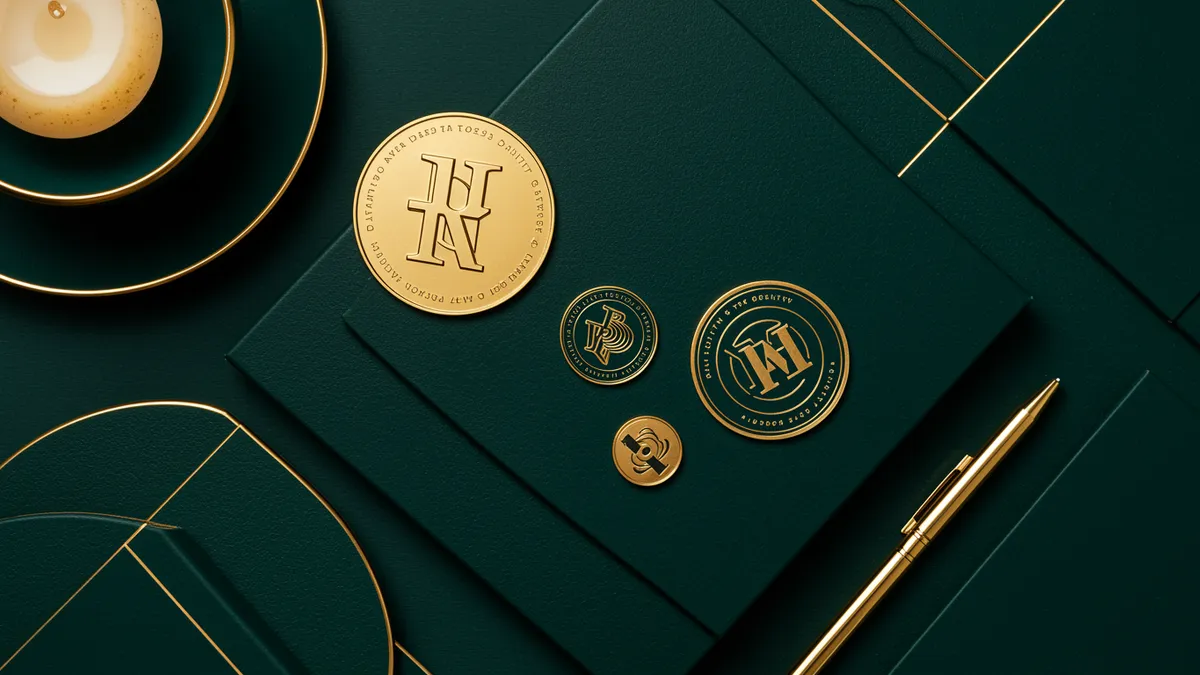
Learn how logo proportions create visual harmony and strengthen your brand identity. Master the techniques that make logos memorable and effective.
Learn how logo proportions create visual harmony and strengthen your brand identity. Master the techniques that make logos memorable and effective.
A logo can feel "off" without anyone being able to explain why. Nine times out of ten, the problem is proportional. Logo proportions govern how the human eye moves across a mark, how the brain processes its shapes, and whether the whole thing registers as trustworthy or amateurish. Get them right, and your design feels inevitable. Get them wrong, and no amount of color theory or clever typography will save it.
Proportional relationships in a logo determine visual hierarchy before a single word is read. Research on visual perception shows that humans assess spatial relationships in under 200 milliseconds Thorpe et al., 1996. That snap judgment happens well before someone consciously evaluates your brand name, tagline, or color palette. Proportion is doing the heavy lifting while everything else waits in line.
Think about it this way: a symbol that's 40% too large relative to the wordmark creates a visual imbalance that the brain reads as "something's wrong here." The viewer can't articulate the issue. They just scroll past. Or worse, they form a negative first impression that sticks.
For anyone building a logo for a new business, this is critical knowledge. You don't need a $50,000 brand agency to nail proportions. You need an understanding of spatial relationships and a willingness to measure rather than eyeball. Affordable brand design starts with getting the fundamentals right, and proportion is the most fundamental of them all.
One thing designers overlook: proportional errors compound across contexts. A slight imbalance that looks passable on a desktop monitor becomes glaring on a favicon or app icon. Before you finalize any mark, test it at a minimum of five sizes. If the proportions break at any of them, go back to the drawing board.
Shapes in logo design carry meaning that operates below conscious awareness. Circles suggest community and continuity. Rectangles communicate stability. Triangles imply direction and energy. But the logo geometry meaning goes deeper than simple shape symbolism; it's the proportional relationships between those shapes that create coherence.
Consider the Apple logo. Its curves follow consistent radii derived from overlapping circles. The Twitter bird (before the X rebrand) was constructed from 15 intersecting circles of specific proportional relationships. These aren't decorative choices. They're structural decisions that make a mark feel unified rather than assembled from spare parts.
A study on aesthetic preference found that designs built on consistent geometric ratios were rated 23% more appealing than those without underlying geometric structure Fechner, 1876; replicated by McManus, 1980. The golden ratio gets most of the attention, but simpler proportional systems work just as well. A 2:3 ratio between a symbol and wordmark height. A consistent radius applied to every curve. Even a basic grid of equal squares can impose enough order to make a logo feel professional.
Here's what's interesting: you don't need to be a mathematician. You need a grid. Start every logo project by establishing a proportional framework, then let that framework constrain your creative decisions. Constraint, paradoxically, produces better design.
Startup logo design demands versatility, and versatility demands intentional proportions from day one. Your mark will appear on pitch decks, social media avatars, product packaging, and potentially billboards. Each context has different spatial constraints, so your proportional system needs to flex without breaking.
Start with the lockup. The "lockup" is how your symbol, wordmark, and tagline relate to each other spatially. Define clear proportional rules:
For founders pursuing affordable brand design, these three rules alone prevent 80% of proportional disasters. You don't need a 60-page brand guidelines document. You need these three numbers written down and followed consistently.
Quick reality check: I've seen startups spend weeks choosing between two shades of blue while their logo's symbol is visually crushing the wordmark beneath it. Priorities matter. Fix the proportions first. Refine the psychology of color second.
Your logo spacing guide should be established alongside your proportional system, not as an afterthought.
Gut instinct has limits. Even experienced designers benefit from objective measurement when evaluating logo proportions, because what feels balanced to the creator often reads differently to a fresh pair of eyes.
Eye-tracking research consistently shows that viewers scan logos in predictable patterns. A well-proportioned mark guides the eye from the most important element (usually the symbol) to the supporting elements (wordmark, tagline) in a smooth, rapid sequence. Poorly proportioned logos create erratic scan paths where the eye bounces between competing focal points Pieters & Wedel, 2004.
This is where it gets tricky. You can't run an eye-tracking study every time you adjust a curve. But you can use neuroscience-backed analysis tools that simulate how viewers will process your design. Running a logo analysis before finalizing your mark gives you data on visual balance, focal hierarchy, and proportional harmony that would otherwise require expensive lab testing.
Some practical tests you can run without any tools at all:
These low-tech checks catch problems that staring at a full-size Illustrator file never will.
Certain proportional errors show up repeatedly in logos designed for new businesses. Knowing what to avoid saves time and revision cycles.
Oversized symbols. First-time founders often want the icon to dominate because they assume bigger equals more memorable. Research on brand recall suggests the opposite: marks with balanced symbol-to-text ratios enjoy higher recognition rates than icon-heavy designs Henderson & Cote, 1998. The symbol should anchor the composition, not overwhelm it.
Inconsistent stroke weights. When lines within a logo vary in thickness without a proportional logic, the result looks hand-drawn in the wrong way. If your thinnest stroke is 2pt, your thickest should relate to it by a clear ratio (2x, 1.5x), not by random variation.
Ignoring optical compensation. Geometric perfection and visual perfection aren't the same thing. A circle that is mathematically the same height as a square will look shorter. Experienced designers make optical adjustments, slightly oversizing rounded elements so they appear proportionally correct. This is one reason font selection matters so much; typefaces with built-in optical corrections pair better with geometrically constructed symbols.
No proportional system for responsive versions. Your logo needs at least three lockup variants (horizontal, stacked, icon-only), and each one requires its own proportional rules. Shrinking the horizontal version to fit a square avatar is not a strategy. It's a compromise that makes your brand look careless.
Sometimes the proportional issues in a logo aren't fixable with minor tweaks. If your mark was designed without an underlying grid, or if it was created for print-only contexts a decade ago, the proportional system may be fundamentally incompatible with modern applications.
A few warning signs: your logo looks cramped inside circular social media frames. The favicon version is unrecognizable. Your team keeps "adjusting" the logo slightly for different contexts because no single version works everywhere. These are signs your logo needs a refresh, and proportional failure is usually the root cause.
Worth noting: a redesign doesn't mean starting from scratch. Many successful rebrands preserve the core symbol and wordmark while rebuilding the proportional framework underneath. Mastercard's 2016 update is a perfect example. The overlapping circles stayed. The proportional relationships between them, and between the circles and the typography, were completely reworked for digital-first applications.
Before committing to a full redesign, run a logo evaluation to identify exactly where the proportional breakdowns are occurring. Sometimes a systematic adjustment to spacing, scale, and clear-space rules is all you need.
No single ratio works for every logo. The golden ratio (1:1.618) is popular but not mandatory. Simpler ratios like 2:3 or 3:5 often work equally well. The key is choosing a ratio and applying it consistently across all elements in your mark, including symbol height, wordmark size, and clear space.
Use the squint test, thumbnail test, and flip test described above. For data-driven feedback, run your design through a logo analysis tool that measures visual weight distribution and focal hierarchy. Compare your results against sample reports to benchmark your proportional balance.
Yes. Research shows that visual harmony, which proportional balance directly creates, correlates with perceived credibility Tractinsky et al., 2000. Disproportionate logos trigger subconscious unease, which undermines building trust through visual identity before a customer even engages with your product.
Often, yes. If the core shapes and typography are solid, adjusting the proportional relationships between them can dramatically improve the mark. Rebuild the spacing system, establish clear ratios, and test across contexts. A full redesign is only necessary when the underlying geometry is fundamentally flawed.
Your logo's proportions are doing invisible work every time someone encounters your brand. Make sure that work is building trust, not eroding it. Ready to see how your mark measures up? Analyze your logo with our neuroscience-backed platform and get objective, data-driven feedback on proportional balance, visual hierarchy, and overall design effectiveness. It takes less than a minute, and the insights can reshape your entire brand strategy.
Master every platform with our logo format guide. Learn which file types work best for web, print, a...

Logo print vs digital optimization strategies for every medium. Learn how to adapt your brand across...
What makes a good logo and how to test yours for maximum impact. Learn design principles that build ...
Get a free scientific analysis with 550+ metrics across perception and design.
Try Free Analysis