industry applicationsbeauty
Beauty Logo Design That Captivates at First Glance
Discover stunning beauty logo design ideas that captivate customers instantly. Learn proven strategi...
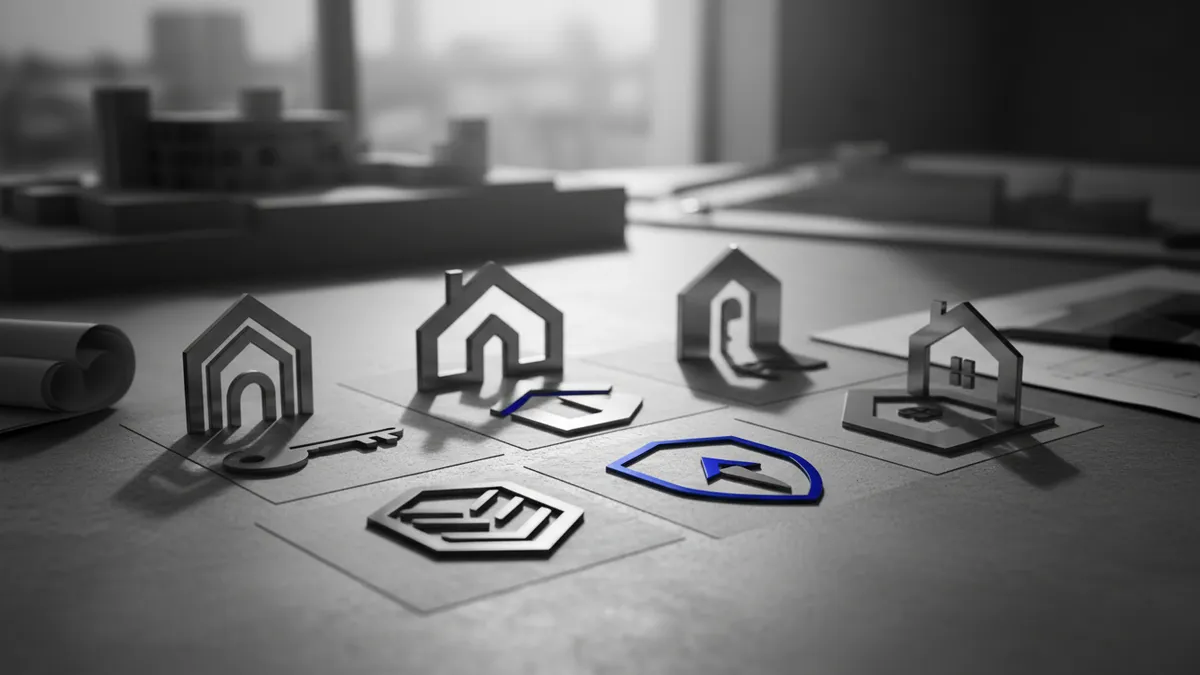
Real estate logo design builds instant credibility with clients. Learn proven strategies to create professional logos that establish trust and grow your bran...
Real estate logo design builds instant credibility with clients. Learn proven strategies to create professional logos that establish trust and grow your bran...
A real estate agent once told me her biggest competitor wasn't another brokerage. It was the instant gut reaction people had when they saw a logo on a yard sign and decided whether to call. Real estate logo design operates under pressure that most industries never face: your mark needs to communicate trustworthiness, professionalism, and local authority in roughly two seconds, often from 30 feet away on a moving car's passenger side.
That's a brutal design brief. And most real estate logos fail it completely.
They default to generic rooflines, skeleton keys, or serif fonts that look like every other agent in the ZIP code. The result? Visual anonymity in a business built entirely on personal reputation. Here's how to fix that.
Real estate transactions are the largest financial decisions most people ever make. Your logo isn't selling a product; it's selling confidence in you. Research on visual trust signals shows that people form credibility judgments about brands within 50 milliseconds of seeing a visual identity Lindgaard et al., 2006. That's not enough time to read your tagline. It's barely enough time to register a color.
So what builds trust at that speed? Three things: simplicity, color consistency, and typographic weight.
Simplicity matters because complex logos trigger higher cognitive load, which the brain interprets as uncertainty. Color consistency matters because familiar, expected palettes (blues, deep greens, blacks) activate associative memory tied to financial institutions and authority. Typographic weight matters because thin, decorative fonts subconsciously signal fragility.
Think about it this way: would you hand someone $400,000 based on a logo that looks like it was made in Canva during a lunch break? Neither would your prospects.
One thing designers overlook: trust signals vary by market segment. A luxury brokerage in Manhattan needs different visual cues than a family-focused agency in suburban Texas. Before choosing fonts and colors, define whose trust you're earning. A logo analysis can reveal whether your current mark actually communicates what you think it does.
Roughly 60% of real estate logos feature a house, roofline, or key icon. I've seen this in portfolio after portfolio. The intention makes sense: show people what you sell. But the execution creates a sea of sameness.
Here's what's interesting: industries outside real estate figured this out years ago. Animal logo design in the pet industry, for example, rarely uses a literal dog or cat anymore. The most successful pet brands lean into personality, energy, and emotional connection instead of obvious imagery. Pet industry branding has evolved past the literal, and real estate should follow.
The strongest real estate logos use abstract marks, monograms, or distinctive wordmarks. Compass uses a simple geometric icon. Sotheby's relies on its name and heritage typography. Douglas Elliman uses a bold "DE" monogram. None of them show a house.
If you must use property-related imagery, abstract it. A single geometric line suggesting a roofline works better than a detailed house illustration. The goal is recognition, not illustration.
Quick reality check: pull up five competing agents in your market and lay their logos side by side. If yours blends in, you have a differentiation problem that no amount of marketing spend will solve. Consider running a logo comparison against your direct competitors to see where you stand.
Color choices in real estate logos should be driven by the emotional state of your target client, not personal preference. Buyers approaching a transaction feel a mix of excitement and anxiety. Sellers often feel urgency and vulnerability. Your palette needs to acknowledge both.
Blue remains the dominant choice for good reason. Research consistently links blue to perceptions of competence and reliability Labrecque & Milne, 2012. Navy blue, specifically, performs well because it carries connotations of depth and established authority without feeling cold.
But blue isn't your only option. Deep green signals growth and stability, making it effective for agencies focused on investment properties. Black and gold combinations work for luxury markets, though they require careful execution to avoid looking like a nightclub flyer. The psychology of color plays an outsized role in real estate because the emotional stakes are so high.
Colors to approach with caution:
Worth noting: your color choices also need to survive the yard sign test. High contrast between your logo and sign background is non-negotiable. A beautiful sage green logo disappears against a white sign in direct sunlight.
The font in your real estate logo does more heavy lifting than the icon. Typography carries implicit personality traits that viewers process unconsciously, and in real estate, the wrong font choice can undermine an otherwise solid visual identity.
Serif fonts (like those in the Didot or Playfair Display families) communicate tradition, establishment, and formality. They work well for brokerages that want to signal longevity and heritage. Sans-serif fonts (like Montserrat or Avenir) communicate modernity, clarity, and approachability. They suit newer agencies or those targeting younger, first-time buyers.
This is where it gets tricky. Many agents choose ultra-thin or heavily stylized fonts because they look elegant on a computer screen. But real estate logos appear on business cards, rider signs, email signatures, vehicle wraps, and tiny social media avatars. A font that looks gorgeous at 200px collapses into illegibility at 40px.
The same principle applies across other visually demanding industries. Beauty brand identity and cosmetics branding face similar challenges: logos must work on everything from a billboard to a lipstick tube. The best beauty brands choose typography that scales gracefully, and real estate professionals should apply the same discipline.
Test your logo at the smallest size it will ever appear. If you can't read the name clearly, your typography needs work. Our analysis methodology evaluates scalability as a core component of logo effectiveness for exactly this reason.
Most homebuyers start their search online. Zillow, Realtor.com, social media ads, Google Business profiles: your logo appears in digital contexts before a prospect ever sees a physical sign. Yet many real estate logos are still designed with print as the primary consideration.
A digital-first approach means designing for:
The agencies getting this right often create a responsive logo system: a full wordmark for large applications, an abbreviated monogram for small ones, and a standalone icon for the tiniest placements. Keller Williams did this effectively with their "KW" mark functioning independently from the full name.
If you're unsure whether your logo holds up across digital contexts, a logo evaluation can identify specific weaknesses in scalability and digital readiness. You might also find it's time to refresh your logo entirely rather than trying to patch a fundamentally print-oriented design.
Some of the sharpest branding thinking happens outside real estate. Pet brand logo design, for instance, has become remarkably sophisticated. Brands like BarkBox and Chewy use playful but polished identities that balance warmth with professionalism. Real estate can borrow that principle: warmth doesn't require sacrificing credibility.
Luxury fashion offers another lesson. As we've explored in our piece on luxury brand logo design that signals true prestige, high-end brands succeed by removing visual noise rather than adding it. Every element earns its place. The same restraint transforms a cluttered real estate logo into a confident one.
And from fashion branding mistakes to fix in your logo today, there's a transferable insight about trend-chasing. Fashion logos that follow momentary design trends age poorly. Real estate logos that chase trends (remember when everyone used watercolor textures?) age even worse, because longevity signals stability in your industry.
The takeaway? Study what works in other fields. Borrow principles, not aesthetics. Your real estate logo design should feel like it belongs to your industry while thinking like the best brands in any industry.
Clean typography, a restrained color palette (navy, deep green, or black), and minimal visual complexity. Trust comes from clarity, not cleverness. Avoid overly decorative elements and ensure legibility at small sizes, especially on yard signs and digital profiles.
Not necessarily. House icons create visual similarity with competitors, making differentiation harder. Abstract marks, monograms, or strong wordmarks often perform better. If you use property imagery, simplify it to a geometric suggestion rather than a literal illustration.
Every 7 to 10 years for a refresh, sooner if your market positioning has shifted significantly. Avoid complete overhauls that erase brand recognition. Subtle modernizations to typography, spacing, or color saturation keep you current without confusing past clients.
Yes, but design it as a system from the start. Create a personal mark that complements your brokerage's branding without clashing. Many top-producing agents use a personal monogram alongside their brokerage wordmark in a consistent visual hierarchy.
Your logo is the first handshake with every potential client. If it's not communicating trust, authority, and professionalism before a single word is spoken, you're losing deals you never knew existed. Run a neuroscience-backed analysis on your current mark, or analyze your logo to see exactly how buyers and sellers perceive your brand in those critical first milliseconds.
Discover stunning beauty logo design ideas that captivate customers instantly. Learn proven strategi...

Discover how AI analysis transforms travel logo design into stunning visual identities. Learn expert...

Learn how construction logo design builds client trust and establishes your brand. Discover proven s...
Get a free scientific analysis with 550+ metrics across perception and design.
Try Free Analysis